Options - Burial Settings
Recording Method 1 or Recording Method 2
Method 1 is the default method in Ancestral Sources. With this method a separate source is created for each burial record (e.g burial parish register entry).
A source title might be:
Burial Preston, Lancashire March 30 1871 Jane Smith
This is probably the best method to choose if you want to keep a transcript of each burial record within your GEDCOM file as the source text can be used for this purpose. This is also probably the best method if you want to link an image of the original burial record to the entry.
Ancestral Sources will automatically create the source based on details entered by you. For the deceased individual it will create a burial or cremation event and perhaps death, occupation, residence, and birth events. For parents or spouse it may create occupation attributes and residence details (if referred to in the source document). All of these facts will be linked back to the source record using citations.
This method will result in you potentially having hundreds of sources in your GEDCOM file, one for each burial entry you create.
Using method 2 a source usually refers to a burial location. A source title might be:
Burials Preston, Lancashire, UK
This is probably the best method if you don't want to record a transcript of each burial entry within your GEDCOM file. If you do want to do this then this method can still be used but will result in larger files as the transcript will appear multiple times within citations.
For the deceased individual Ancestral Sources will create a burial or cremation event and perhaps death, occupation, residence and birth events. For parents or spouse it may create occupation attributes and residence details (if referred to in the source document). All of these facts will be linked back to the source record using citations.
This method will usually result in you having very few sources in your GEDCOM file but a lot of repeated information in citations.
In the author's opinion if you want to record a transcript of each burial record and/or include links to images of the original burial or cremation entry then Method 1 is probably the best choice. If however you just wish to record the details without going to the trouble of including a transcription then you could use Method 2.
Please note that some users refer to Method 1 as 'Splitter Sources' and Method 2 as 'Lumper Sources'. This is because Method 1 users split their data across multiple sources, whereas Method 2 users lump lots of entries together under a single source.
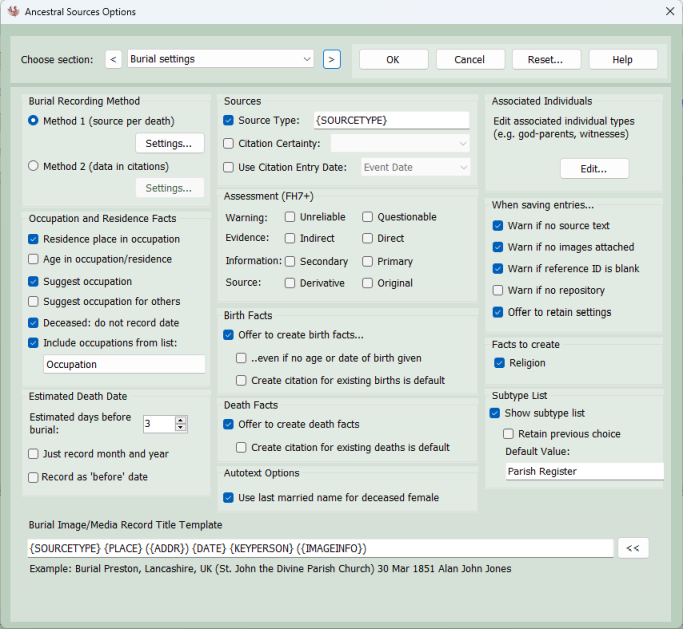
Occupation and Residence Facts: When creating an occupation fact for the deceased or their spouse or parents, the address is not filled in as it is unlikely that the place where the individual lived was also the address of their work-place. However, there is a good chance that they worked in the same town/village. If the Residence place in occupation option is selected then the place recorded as residence for the father or mother will be recorded in the occupation place too. Age given in a burial source is frequently not accurate and in the author's opinion, the age given is not really relevant to the residence and therefore should be recorded in the death fact and not in the residence fact. However, there is an option to Record individual age in residence for those who wish to do this. If Suggest occupation is ticked then Ancestral Sources will attempt to suggest the occupation of the deceased individual. If Suggest occupation for others is ticked then the occupation will also be suggested for their spouse and/or father and/or mother.. If most of your burial records don't mention occupations then you may prefer not to use this option and just enter the occupation yourself. If the spouse or either of the parents are deceased but have an occupation recorded in the record, then it may not make sense to record a date after they died in the occupation fact. If Deceased: do not record date is ticked then the occupation date will be left blank in these circumstances. If this is unticked then the date will be recorded as being before the event date.
By default, the list of occupations will include those specified in the Occupation list defined on the Edit Lists screen. You can edit that list yourself or even specify a list of occupations that can differ from source to source by creating a new list and choosing the name of the list on this options page.
Estimated Death Date: When a burial or cremation record is saved, Ancestral Sources will give you the option to create a death fact too. If a date of death is not entered then you will be offered the chance to create an estimated death date instead. You can set the number of days before the burial to use as the estimated date, by default this is 3 days. You can opt to just record month and year if you wish. Note that this is based on the number of days before the burial. e.g. if a burial happened on 1st May 1801 and Estimated days before burial was 3 and Just record month and year was ticked then the suggested estimated date of death would be April 1801. If you want the estimated month and year to always match the burial or cremation record then you should set the estimated days value to 0. If record as 'before' date is selected then the suggested death date will be a before date rather than an estimated date. If you wish to just record date of death as being before the funeral date then set the estimated days value to 0.
Note that this same estimated death date options will be used when creating residence and occupation facts that are derived from a burial record where date of death is not recorded.
Source Types: The text entered here will be recorded in the Source Type tag for any death sources created. The source type is a Family Historian extension to GEDCOM. By default the source type uses a tag {SOURCETYPE} which will be either Burial or Cremation, depending on whichever of these is selected when the source is created.
Citation Certainty: If this option is selected then the reliability assessment will be recorded with each citation created. See also the Assessment (FH7+) option below.
Use Citation Entry Date: If this option is selected then the burial or cremation date will be recorded in the GEDCOM entry date field in every citation. Some users prefer to use this field to record the date that they entered the information into Ancestral Sources. This is not the intended use of this field as specified in the GEDCOM standard but the option is there for those users who choose to use it for this purpose.
Birth Facts: With the default settings, when saving a burial entry Ancestral Sources will give you the option to create or modify a GEDCOM birth fact for the deceased (age or date of birth and/or birth place are sometimes recorded in a burial source). The create citation for existing births is default setting dictates whether the create citation for birth tickbox is ticked by default on the birth screen when opting to not change an existing birth event. See the help page for the Birth Events from Entry screen for more details.
Assessment (FH7+): Family Historian 7 introduced new citation assessment/certainty options. If your file is a Family Historian 7 (or later) file and any of these options are selected then these will be added to all citations created for burial sources. This will override the Citation Certainty option (see above). If none of the assessment options are ticked then the Citation Certainty option will apply instead.
Death Facts: With the default setting, when saving an entry you will be given the option to create or modify a GEDCOM death fact for the deceased and any deceased parents or spouse referred to in the source using the Death Events from Entry screen. The create citation for existing deaths is default setting dictates whether the create citation for deaths tickbox is ticked by default on the death screen when opting to not change an existing death event. See the help page for the Death Events from Entry screen for more details.
Autotext Options
If use last married name for deceased female is ticked then the last married name for the individual will be used in autotext entries. If it is not ticked then the their primary name in the GEDCOM file will be used.
Associated Individuals: This will display the Associated Individual Types screen which will allow you to specify how other related individuals such as mourners are recorded in your file, if they referred to in the source document.
Warnings when saving entries: It is possible to forget to enter all of the source data. You can opt to have Ancestral Sources warn you if you forget to enter source text, select images, enter a reference ID, select a repository, or enter a registration date.
Offer to retain settings: If this is ticked the Retain Data screen will be shown after an entry is saved.
Facts to Create - Religion: If the religion of the deceased individual is specified in the source record then these details can be entered into the Ancestral Sources main screen. If this option is ticked then a GEDCOM Religion fact will be created for the individuals. If it is not ticked then the religion can still be entered and referred to if the auto-text template refers to the RELIGION keyword.
Subtype List: All source types other than Census have the option to display the subtype list on the main screen. For example this allows you to specify if a burial record is a parish record or bishop's transcript, etc. The contents of these lists can be modified on the Edit Lists screen. There are options to specify the default value to show and whether to retain the previously selected list item each time.
Image Title Template: When linking images to a burial record using the Image Viewer there are options to name the multimedia record and optionally rename the image file to match. One of the options is to create a title based on the Image Title Template. You can type the title template into the box and select tags from the list to include within the template. So, for example, If the template was: {SOURCETYPE} {PLACE} {DATE} {KEYPERSON} ({IMAGEINFO}) then the {SOURCETYPE} would be replaced by Burial or Cremation (depending on the choice made on the main screen), {PLACE} and {DATE} will be replaced by the values entered into the burial date and place text boxes. {KEYPERSON} would be the name of the deceased individual. When you add a new image there is an additional information box to optionally enter text to add to the image title replacing the {IMAGEINFO} tag. When adding multiple images to a source this could be used to distinguish between them. In the example above if the additional information textbox was left blank then Ancestral Sources will automatically remove the () brackets as they are unnecessary. Therefore the image might be given the name: Burial Preston, Lancashire 1 Jan 1800 Jane Smith. Note that having a template specified here does not imply that the template will definitely be used. It will only apply if the appropriate option is chosen when linking an image on the Image Viewer screen. The main tags: {ADDR} - Address field, {OTHER} - Other Information field, {DATE} - burial date, {YEAR} - burial year, {PLACE} - Place where burial occurred, {SOURCETYPE}, {KEYPERSON} - the name of the deceased individual in Forenames Surname format. There are other KEYPERSON sub-tags available to control the format in which the key person's name is displayed. There are also sub-tags to display the date of death {DEATHDATE} and cause of death - {CAUSEOFDEATH}. See Template Keywords and Functions for further information.
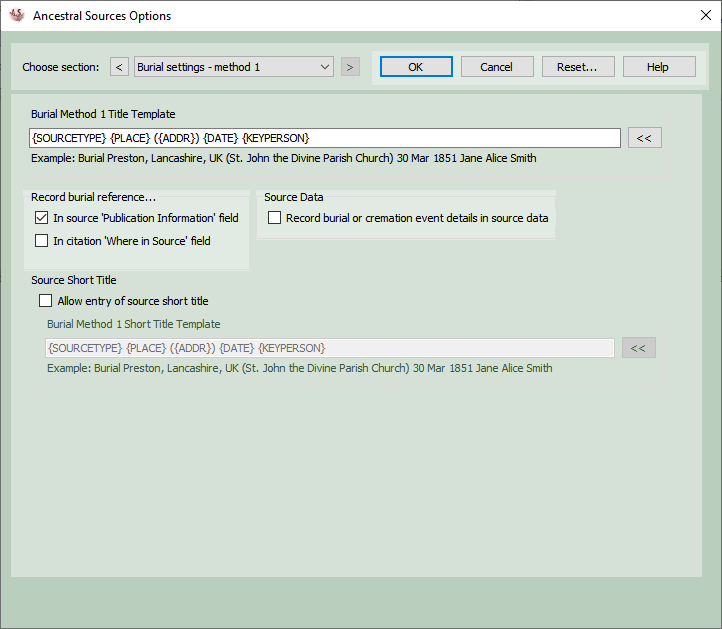
These settings are available if burial recording method 1 has been chosen on the Burial Settings page.
Burial Method 1 Title Template: When using method 1 a source is created for each entry, the name of this source is based on the template. So, for example, If the template was: {SOURCETYPE} {PLACE} {DATE} {KEYPERSON} then the {SOURCETYPE} would be replaced by Burial or Cremation (depending on the choice made on the main screen), {PLACE} and {DATE} will be replaced by the values entered into the burial date and place text boxes. {KEYPERSON} would be the name of the deceased individual. The main tags: {ADDR} - Address field, {OTHER} - Other Information field, {DATE} - burial date, {YEAR} - burial year, {PLACE} - Place where burial occurred, {SOURCETYPE}, {KEYPERSON} - the name of the deceased individual in Forenames Surname format. There are other KEYPERSON sub-tags available to control the format in which the key person's name is displayed. There are also sub-tags to display the date of death {DEATHDATE} and cause of death - {CAUSEOFDEATH}. See Template Keywords and Functions for further information.
Record burial reference: You can opt to record the reference id in the publication information field which is part of the source, or in the where in source field in every citation. Using the where in source option will result in the reference appearing in multiple places in the file which is not really recommended for method 1. So instead either use the publication information field or make sure you include the reference in the title template.
Record burial event details in source data: There is a feature of GEDCOM of which even many experienced users of Family Historian will not be aware and it is unlikely that this option will be used often. It is possible to record the types of event that are recorded within the source, together with the date and place. If this option is selected then a burial or cremation event, together with date and place will be attached to the source when it is created.
Source Short Title: If this option is ticked, the main screen will allow you to create a short title for a source as well as the usual long title. Although not selected by default, some users like to record a different short title for their sources and you can specify a title template for this. If this option is ticked the Title label on the main screen will become a link which allows you to toggle between viewing or editing the long title or the short title.
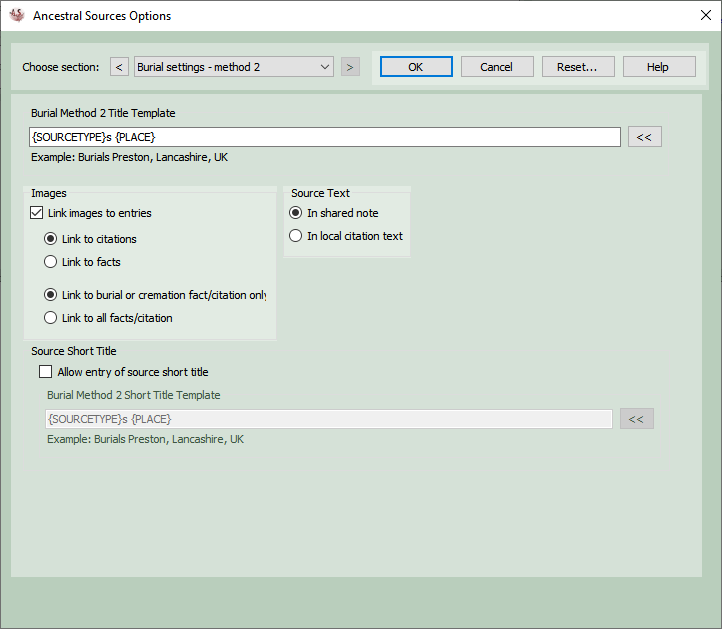
These settings are available if burial recording method 2 has been chosen on the Burial Settings page.
Burial Method 2 Title Template: Usually method 2 entries link to an existing source which might be called Burials Preston, Lancashire. However, if this source doesn't exist the main screen provides the option to create a new source, the title of which is based on this template. You can type text into this template and select tags from the list to include within the template. These tags are then replaced with the appropriate values when the source is created. For example if the template was: {SOURCETYPE}s {PLACE} then the source created might be Burials (or Cremations) Preston, Lancashire. Useful tags include: {ADDR} - Address field, {OTHER} - Other Information field, {PLACE} - Place field, {SOURCETYPE}. See Template Keywords and Functions for further information. It should be noted that it is unlikely that the {REF} or {KEYPERSON} keywords will be used in method 2 templates.
Images: If the option to link images to entries is ticked then the user can choose whether these images will be linked to the citation or to the fact itself. Technically there isn't really much difference between these two options. The user can also decide whether they want the multimedia image record to be just linked to the burial/cremation fact/citation or to every fact/citation that is created for the entry (e.g. Births, Occupations, etc.).
Source Text: It is always recommended that method 1 should be used if transcriptions of the burial entries will be made. However, if a method 2 user wishes to record data in the source text field on the main screen then they can. The obvious option here might seem to be to record the data in the citation text field. However, a typical burial entry will probably lead to several citations being created (for burial, death, occupation, birth, residence, etc.) which would mean several separate copies of the source text being saved. Another option therefore is to create the source text within a note record and have a link to this note from each citation. This avoids the duplication of the source text. If the source text ever needed to be edited in the future it would only need to be edited in one place rather than in each of the citations.
Source Short Title: If this option is ticked, the main screen will allow you to create a short title for a source as well as the usual long title. Although not selected by default, some users like to record a different short title for their sources and you can specify a title template for this. If this option is ticked the Title label on the main screen will become a link which allows you to toggle between viewing or editing the long title or the short title. Please note that this option does not apply if templated sources are used (Family Historian v7 or later).