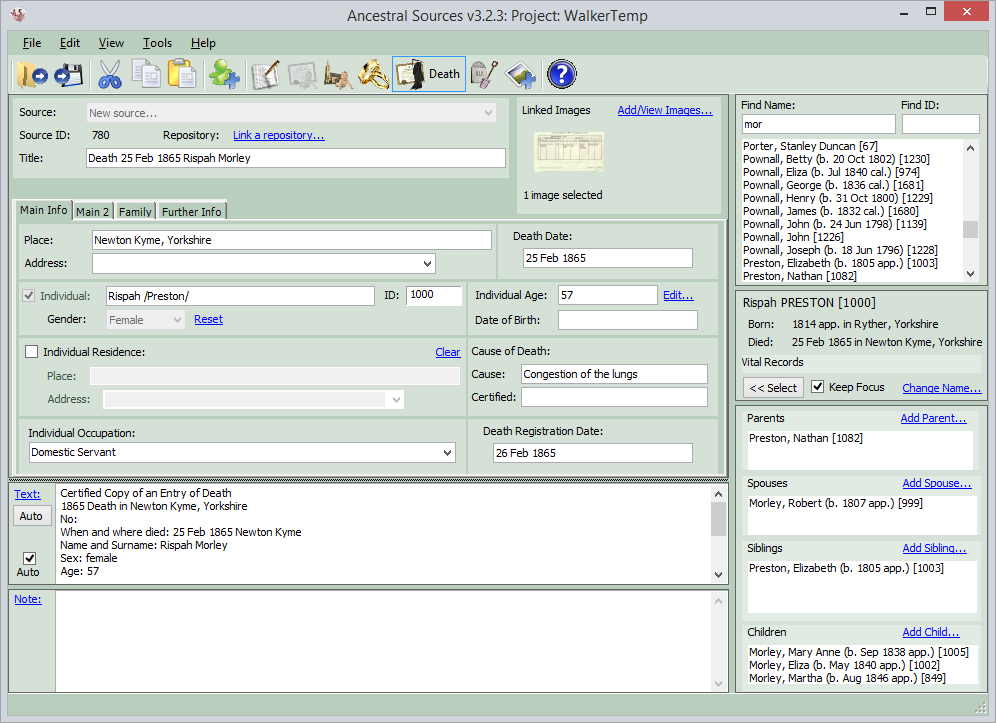
Ancestral Sources Main Screen: Death Records
The help for this page is split into the following sections:
File Menu
Open FH Project: This menu item will only appear if Ancestral Sources detects that Family Historian 4 or 5 (or later) is installed on the computer. Family Historian 4 was the first version to include 'projects'. If your family history file is part of a project then this option should be used. The file will be opened, individuals displayed and the record details can then be typed in. Also available as a shortcut on the tool bar.
Open Gedcom File: Select the GEDCOM family history file to be edited. The file will be opened, individuals displayed and the record details can then be typed in. Also available as a shortcut on the tool bar if your PC does not have Family Historian 4 or 5 (or later) installed.
Current Project/File is default: If this item is ticked then the current file or project will be opened automatically whenever Ancestral Sources starts. If you no longer want the current file to be opened each time then un-tick this option.
After Save: There are options to have Ancestral Sources automatically close after the successful save of an entry or alternatively to minimise. Some users prefer to always view an entry in Family Historian following a successful save and this makes that process easier.
Save entry to File: Once all of the various text boxes have been filled in, the individuals have been added to the grid, images linked (if applicable), source text filled in (if applicable), etc. then choose this menu item to add the entry to the file. Also available as a shortcut on the tool bar.
Recent Files/Projects: Shows the most recently accessed files and/or projects. Click on one of these to open.
Exit: Choose this to finish using Ancestral Sources.
Edit Menu
Cut: Cuts the currently selected text. Also available as a shortcut on the tool bar. Ctrl+X can also be used as a shortcut
Copy: Copies the currently selected text. Also available as a shortcut on the tool bar. Ctrl+C can also be used as a shortcut
Paste: Pastes text previously cut or copied into the clipboard into the current text box at the insertion point. Also available as a shortcut on the tool bar. Ctrl+V can also be used as a shortcut
Delete: Deletes the currently selected text. The delete key can be used as a shortcut
New unrelated individual: Creates a new individual unrelated to anyone in the GEDCOM family history file using the Add New Individuall screen. If this individual is related to someone in your file then instead they should be added as either a parent, spouse, sibling or child of the individual in question. See the section Selecting Individuals below. This is also available as a shortcut on the tool bar.
Review/remove individual data changes: New individuals added or renamed can be viewed and if necessary deleted. See the help page for this.
Add current individual to the entry: The currently selected individual is added to the record. This item is also available via the Select button in the Individuals panel. See the section on Selecting Individuals below.
Add New Parent/Spouse/Sibling/Child: If an individual has been selected these can be used to add a new relation to them. These options are also available using the links in the Individuals panel. There are keyboard shortcuts available: Ctrl+Shift+P to add a new parent, Ctrl+Shift+S to add a new spouse, Ctrl+Shift+B to add a new sibling, Ctrl+Shift+C to add a new child.
Auto Text: This causes the source text box to be filled with a text representation of the data entered. This is also available by using the Auto button next to the source text button. See the section on Source Text and Notes below.
Add/View Images: This opens up the Image Viewer screen to enable images to be linked to the record or viewed. This can also be achieved by clicking on the Add/View Images link in the Linked Images panel. See the section on Death Information below.
Edit Templated Source: This option will only be shown if the option to used Templated Sources is selected. This menu item performs the same task as clicking the Edit Templated Source... link described in the Source section below.
Link a Repository: This option will only be shown if Templated Sources are not being used and the option to use repositories is selected. This menu item performs the same task as clicking the Link a repository link described in rhe Source section below.
Edit Source Text: This menu item carries out the same task as selecting the Text link described in the Source Text and Notes section below.
Edit Source Note: This menu item carries out the same task as selecting the Note link described in the Source Text and Notes section below.
Clear/Reset Current Entry: This will clear all text boxes, images selected, etc. so that you can begin to enter again.
View Menu
This menu allows the user to choose the type of entry they wish to enter. These options are also available on the tool bar. In the current version of Ancestral Sources census, birth, baptism, marriage, death, burial/cremation and monumental Inscription sources are supported as well as the ability to add images to existing sources.
Show Parent/Spouse Birth Fields: If this option is selected then additional fields will be displayed on the Residence panel to allow for entry of the place of birth, date of birth and/or age of the parents and spouse of the deceased individual. As these fields are not commonly included in death records this option can be used to show or hide them as required.
Tools Menu
Autotext Template Editor: This opens the Autotext Templates screen which can be used to create templates for use with the source-text Auto button. See the section on Source Text and Notes below.
Source Templates: This opens the Source Template Editor. Family Historian 7 introduced the concept of Source Templates which add additional fields to sources to allow more structured citation information to be recorded. You can use this feature if you have Family Historian 7 or later and use recording method 1.
Flag Assignment: This opens the Flag Assignment screen to allow you to specify that Family Historian flags be added to individuals when an entry is made.
Flag Batch Add: This opens the Flag Batch Add screen that enables you to retrospectively apply flags to individuals based on the existing event/source types previously applied.
Address Merge: This opens the Address Merge screen. This allows addresses that have been recorded inconsistently for a place, to be merged into one. Note that this option will cancel any existing entry that is partially complete.
Customise: This opens the Customise screen which allows the user to choose an existing colour scheme or their own scheme for Ancestral Sources. It is also possible to change the font and font size used throughout. Sometimes changing the font size doesn't satisfactorily resize the various text boxes and panels on the screen. This is usually solved by closing and re-opening Ancestral Sources. Be aware that larger font sizes will require forms to be resized to a larger size and it is possible that users with smaller screen resolutions and/or with larger DPI settings will not be able to see all of the information on the screen. In this situation it is recommended that you use the smallest font size (8). This screen also allows you to specify the size of the toolbars used on the main screen and when editing richtext.
Edit Lists: This will display the Edit Lists screen which allows you to customise some of the drop-down lists of items shown for different source types, including the standard list of occupations.
Project Specific Settings: This menu item will only be visible if the project that is open has been used by Ancestral Sources on other computers. See the Project Settings help page for details.
View Log Files: This opens the Log File Viewer screen. Each change made to the GEDCOM family history file when entries are saved is logged and these can viewed on this screen.
Options: This opens the Options screen which allows various settings to be changed.
Backup A.S. Options: Use this option to backup your Ancestral Sources settings to a compressed zip file. This zip file will contain the 4 XML settings files used by Ancestral Sources (in the Settings folder specified in the Options screen. It will also include a backup of the registry settings which are machine specific - these will only be able to be restored to the same computer. By default this backup will be saved to the Backup folder specified in the Options screen. If your PC ever needs to have Windows reinstalled or you wish to transfer your settings to another PC then backup your setting to a file. Once Ancestral Sources is installed on your new PC (or newly installed operating system) you can then choose 'Restore A.S. Options' and select all the settings files.
Restore A.S. Options: See Backup A.S. Options above for details.
Help Menu
This menu has links to this help file. In addition it has the following menu items:
Ancestral Sources Forum: This will open up the Ancestral Sources forum at the Family Historian User Group website.
Email Support: This will open up an email window to contact the author of Ancestral Sources
Show Welcome Screen: The welcome screen is displayed every time Ancestral Sources opens unless the user has unticked the option to show the screen on startup. This menu item causes the welcome screen to be shown.
Check for updates: This will connect to the Ancestral Sources website to see whether a new version of Ancestral Sources is now available.
Make a donation: Ancestral Sources is free to use but many users opt to make a donation to the author to encourage him to keep developing the software. Choose this option to make a donation.
About Ancestral Sources: Shows the version number and some acknowledgements.
On the right hand side of the main screen is a panel to allow individuals to be selected and added to the entry. Once the GEDCOM family history file has been opened all of the people in the file are displayed in the list at the top of the panel, in alphabetical order. Depending on the Options chosen after each name the date of birth and/or ID will be shown. You can either scroll through the list to find an individual or type their name or ID into the text boxes at the top.
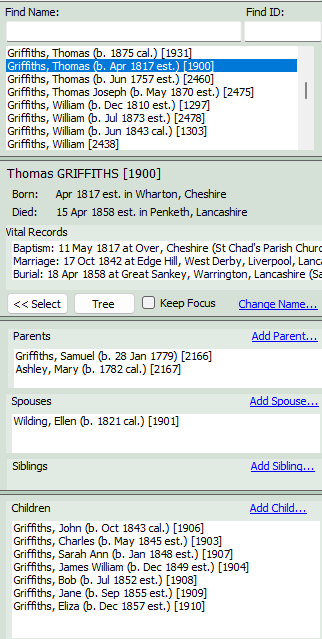
The individual highlighted in the list will be displayed in the panel below. This includes a list of 'vital records' already entered for this individual if there are any: e.g. baptisms, marriages, burials.
If the Main Info tab is currently displayed then you can choose to either select the deceased individual and then click on the <<Select button. When you select the individual then you will be asked to select any parents or spouses that are referred to in the death record. Those that you will select will then appear in the Family tab.
If the Main 2 tab is active then the individual you select will be added as the informant (the person who registered the death) as described below.
If the Further Info tab is active then the individual you select will be added as an associated individual as described below.
Once an individual is selected the four lists below will have people added if applicable to show their known parents, spouses, siblings and children. By clicking on individuals in these lists it is possible to navigate through the relatives of the individual.
If you need to select an individual who does not exist in the file then you can add them as a parent, spouse, sibling or child of the individual currently displayed by using one of the options Add Parent, Add Spouse, Add Sibling, Add Child. Alternatively an entirely new individual with no known link to anyone in the file can be added using the New unrelated individual toolbar or Edit menu item. Whichever of these options is chosen will cause the Add New Individual screen to appear.
There is also a link Change name which brings up a window to allow you to enter a new name for the individual. A citation will be created for this when the source is saved assuming the 'name citation' option is ticked in the Option screen. Alternatively you can change the name of a selected individual/father/mother by simply editing their names in the main info or family tabs.
If the selected individual has children recorded then the Tree button will be enabled. This can be used to display a descendant tree for the individual. This Tree View can be used as an alternative method to select individuals.

Source
If recording method 1 is being used (See Options) then Ancestral Sources will automatically create a new source when the record is saved with the source id displayed and the title shown in the Title text box. The title is based on the method 1 title template specified in the Options screen. Alternatively a title can be entered manually by the user.
If you are using recording method 1 with a file created in Family Historian version 7 (or later) and have opted to use Source Templates then you will see a link button to open up the source template screen. It is best to use the source template screen after filling in the other relevant data on the screen (dates, place, address, etc.) as some of the source template fields may be automatically populated with that data.
If recording method 2 is being used then an existing source can be chosen from the drop down list and this is the source that the facts created will be linked to via citations when the entry is saved. Alternatively a new source can be created by selecting New Source... from the source list. This would only be used where a suitable source does not exist. The source created would have the Source ID specified and the title shown in the Title text box. The title is based on the method 2 title template specified in the Options screen. Alternatively a title can be entered manually by the user.
If the Source Short Title option has been selected then the Title label will instead show as a link entitled Long Title. Clicking this link will allow you to toggle between the long title and the short title for this source. The short title will also be based on the template specified or you can edit the short title manually.
If a new source is being entered or if the source selected does not have a repository recorded, then the user can optionally choose to Link a Repository. A repository can be used to record where this particular source was found, e.g. a website, library or record office. Clicking on Link a Repository will bring up the Repository screen where a new or existing repository can be selected.
>>>>
Linked Images
To link multimedia images of the Death to the entry click on Add/View Images and the Image Viewer screen will appear. Any number of images can be linked though it is unusual for a death certificate to be spread over more than 1 image. As each is linked a thumbnail of the image will appear in the Linked Images panel.
Tabs
There are 4 tabs available to select panels in which to enter information.
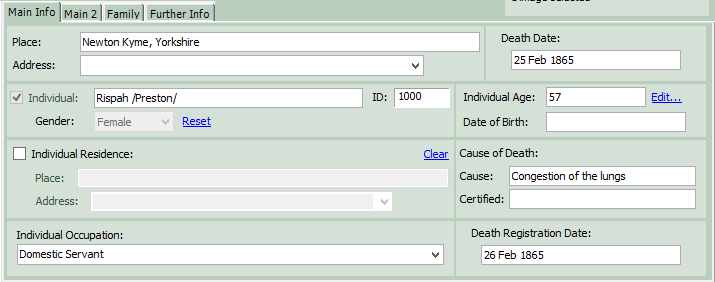
Place and Address (Main Info Tab)
The place where the death occurred can be entered in the place text box. As you enter the title Ancestral Sources will try to predict the place being entered by looking for the most frequently occurring place in the GEDCOM family history file. The death place is the town or village, e.g. Warrington, Lancashire, England.
Once the place has been entered an address can be typed in, this would be the house number/name or hospital and road (if known) within the place specified. Alternatively an address that has already been recorded for the place can be selected from the address drop-down list.
In additional, all Place/Address controls have a button next to the Place text box that opens up the Place and Address Picker which allows the place to be searched with more flexibility.
Death Date (Main Info Tab)
The date of the death needs to be entered into this text box. This can be a partial date if necessary, i.e just month/year or just year.
Individual (Main Info Tab)
The deceased individual can be specified by selecting individuals from the individual lists as explained in the Selecting Individuals section above. When you select the individual you will be asked whether their parents and/or spouse are also referred to in the death certificate. Selecting them will result in them being added to the Family tab. If you click Reset then the individual will be de-selected from the entry to allow you to choose a different individual. Any other details entered for them such as occupation and residence will also be cleared.
Individual Age and Date of Birth (Main Info Tab)
Some death entries include age and/or date of birth. For age a number on its own is assumed to be an age in years but you can follow numbers with either y, m or d to represent years, months or days (e.g. 3y 2m 3d). Alternatively you can click on the Edit... link to display a dialogue to enter these values. The birth date can be a full date, or just a month and year or just a year. If age or date of birth are not specified in the death record then just leave them blank
Individual Residence (Main Info Tab)
If the deceased individual's residence place and (optionally) address are specified then these will be recorded as residence facts for each of them in the file when the record is saved. A residence fact will not be created if the place and address are left blank. If you want the residence details to be recorded because they are implied by the death record but are not actually specifically mentioned, then enter the details but untick the box. If you use an autotext template to generate a transcript of the death record then the unticked fields will not be included.
Cause of Death (Main Info Tab)
If the cause of death is referred to in the source document then this information can be entered here. Many death certificates describe the Doctor who certified the cause of death (e.g. Certified by J. W. Smith MB). This information can entered in the Certified by field.
Individual Occupation (Main Info Tab)
Enter the occupation of the deceased if these details are given in the death certificate. If occupations are already recorded for these individuals, Ancestral Sources may automatically fill in these fields. If the occupations do not match those given in the death record then edit or clear the text.
Death Registration Date (Main Info Tab)
Enter the date that the death was registered into this text box. This can be a partial date if necessary, i.e just month/year or just year.
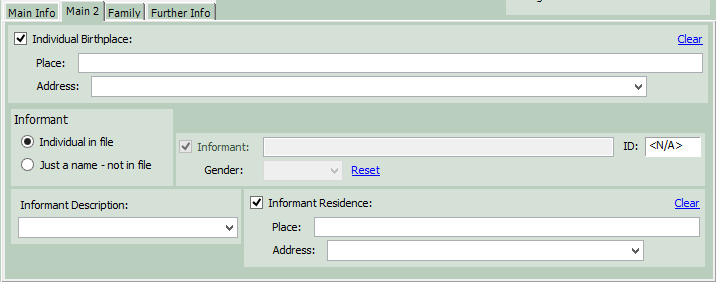
Individual's Birthplace (Main 2 Tab)
If the place of birth and (optionally) address are specified for the deceased, then this information can be entered and optionally recorded as part of a birth fact when the file is saved depending on the choice made on the Birth Events screen when the record is saved.. If you want the birth details to be recorded because they are implied by the death record but are not actually specifically mentioned, then enter the details but untick the box. If you use an autotext template to generate a transcript of the death record then the unticked fields will not be included.
Individual Marriage Status and Religion (Main 2 Tab)
Some death records refer to the marital status and/or religion of the deceased individual. You can choose, for example, 'single' or 'married' from the drop-down lists or type in a different marriage status. If an auto-text template that includes the MARITALSTATUS keyword is not being used then there is no reason to fill this in.
If a religion is entered then this may be saved as a religion event for the individual if the relevant Death option is ticked. If this option is not set and you are not using an auto-text template that includes the RELIGION keyword then there is no reason to fill this in.
Informant (Main 2 Tab)
Death certificates usually include information about the person who reported the death. This could be somebody in your family history file or you may wish to just record their information. If the person is in your file then select Individual in File and then choose an individual from the lists in the right-hand panels in the usual way. When you select the individual then Ancestral Sources may automatically fill in the Informant Description otherwise enter this yourself. If Just a name - not in file is selected then simply enter the name of the informant. If applicable, you can also select text from the Informant Information list such as 'present at death' or 'in attendance' (the contents of this list can be modified on the Edit Lists screen. The residence of the informant can also be recorded in the usual way. If an individual in the file is specified then a residence fact will be created for them with a citation to the source. Other than this particular case (informant residence) any information entered for the Informant will only appear in the auto-text source text and therefore if you don't use auto-text to create a transcription of the entry then there is no point in entering the informant information.
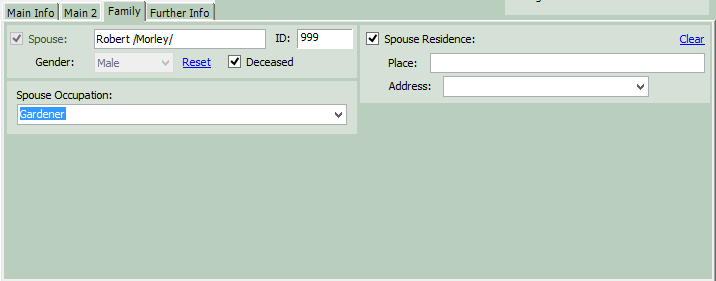
Father, Mother and Spouse Information (Family Tab)
When you select the deceased individual you are given the option to select the parents and/or spouse who may also be referred to on the death source. The Family Tab will include sections to add information for the individuals that you selected. For example, if only the spouse was selected you will not have any fields related to the parents. If no parents or spouse are included then the Family tab will be blank. If occupation or residence of these individuals are referred to in the source record then you can enter these details too. If, for example, the spouse's residence isn't referred to in the record but you think it is reasonable to conclude that they lived with the deceased then you could enter the spouse's residence to match the deceased residence but untick the box so that the information doesn't appear in the source text produced from an auto-text template.
Occasionally a parent or spouse might be recorded in the death entry as also being deceased. In this case tick the relevant deceased tick-box. For deceased parents and spouse there are options available to create a death fact for them and/or to not record the date of a given occupation.
If the Show Parent/Spouse Birth Data menu option or corresponding toolbar button has been selected then additional fields will be available to enter in the birth date, age and place of birth of the parents or spouse if they are referred to in the death record.
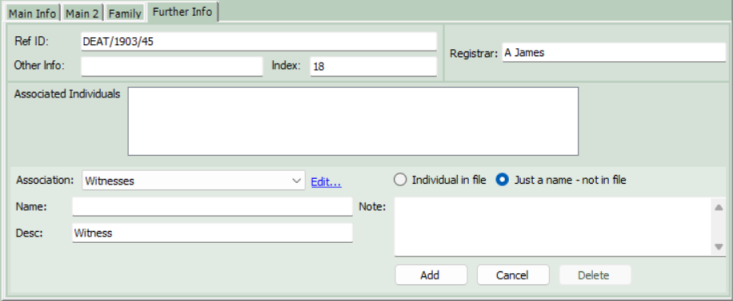
Ref ID (Further Info Tab)
If the source document record is identified by a reference/citation number then it can be typed into this field. If you are using recording method 2, or you have the relevant option set for method 1, this information will be recorded in the Where in Source source citation field. There is a further option for recording method 1 to save this data in the source Publication Information field.
Other Info
This is a box to enter information into as required by the user which will appear in either the source title and/or the image title. Note that if the {OTHER} tag isn't included in the template for the source or image title or autotext template or source template, then there is no point entering data into this box as it won't be recorded anywhere.
Index
Death certificates and other records often include an index number which may be a short number compared to the longer reference/citation details. The index field can be used to record this information. Note that if the {INDEX} tag isn't included in the template for the source or image title or autotext template or source template then there is no point entering data into this box as it won't be recorded anywhere. If you don't wish to use the Index field then this can be hidden via the Options screen.
Registrar
The name of the official registrar of the death. This data is linked to the Note that if the autotext {REGISTER} or {MINISTER} tag isn't included in the autotext template that generates the transcription in the source text, then there is no point entering data into this box as it won't be recorded anywhere.
Associated Individuals
Ancestral Sources provides the facility to record other individuals associated with the death record. For baptism and marriage records associated individuals may be god-parents and witnesses but for deaths there aren't any obvious associated individual types. However, you may decide to create association types using the Associated Individual Types screen.
You may choose to select an individual from your file to be an associated individual, by selecting the Individual in file option, or choose to just enter the name of the associated individual by selecting Just a name - not in file. When you have selected an individual or entered their name just click on the Add button in the Associated Individuals panel and they will be added to the list of associated individuals above. You may then add further associated individuals. If need be you can click on one of the associated individuals in the list and make changes and then press the Update button or click on delete if necessary.
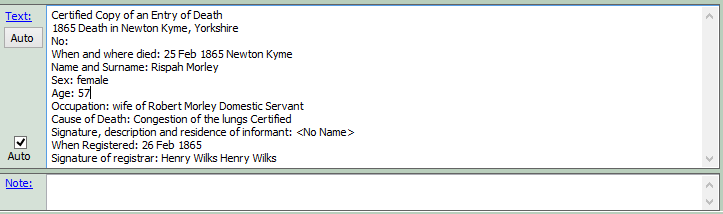
If death recording method 1 is being used then multi-line text boxes will be displayed to enter source text and source note entries. These will be saved to the source created. Usually the source text is used to transcribe the death entry and the source note is used to specify any other information about the death entry if required (e.g. that the writing is difficult to read). These text boxes can be resized as required. The Text and Note titles are underlined as they are links. If clicked on a larger window will appear to make it easier to record the information.
If death recording method 2 is used then only the source text box will be shown. Depending on the options chosen the text will either be saved into the citation text or to a shared note linked to each citation.
Family Historian 7 introduced support for rich text notes and sources for the first time. Depending upon the options selected these source and note text boxes may be shown in rich text or plain text modes. See the rich source text help page for more information.
The easiest way to transcribe a death record is to click on the Auto button. You will then be able to choose an appropriate template which will fill in the source text box with text including the contents of the various text entered into the fields described above. You may need to edit the source text to ensure an accurate transcription is made. It is also possible to use the Auto-text Templates screen to create your own templates or edit existing templates. When Auto has been clicked, a tickbox appears (also labelled Auto). Unless you untick this box or manually edit the source text, the source text will continue to be updated as you make changes to the fields on the screen.